

Tag: Hybrid Training

  • Why Spring Is Perfect for Strength and Conditioning Training

    Why Spring Is Perfect for Strength and Conditioning Training

    Average woman jogging on a paved park path in early spring, wearing a light windbreaker and leggings, with cloudy bright sky and trees with new leaves in the background.

    Spring is right around the corner, and every year when people feel the urge to start training again. The weather improves, the days get longer, and energy levels seem to come back after the slower winter months. Gyms get more crowded, parks fill up with runners, and motivation feels easier to find.

    The problem is that many people return to the same routines that never worked for them before. Some go back to doing only cardio, hoping to lose weight quickly. Others focus only on lifting weights, but never challenge themselves enough to see real change. If you are unsure whether your workouts are actually difficult enough to create progress, you may want to read Are You Lifting Heavy Enough? A Simple Guide to Muscle Growth and Fat Loss, which explains why many people train consistently but never see the results they expect. These approaches can work for a short time, but they often lead to burnout, frustration, or progress that stalls.

    Spring is actually the perfect time to train differently. Instead of choosing between lifting and cardio, this season is ideal for combining both. Strength and conditioning training, sometimes called hybrid training, allows you to build real fitness without feeling stuck in one extreme or the other.

    What Strength and Conditioning Training Actually Means

    Man with an average build performing dumbbell lunges in a clean, modern gym, holding moderate-weight dumbbells, wearing a gray t-shirt and black shorts, natural lighting, realistic training environment, focused expression, documentary fitness photography style

    Strength and conditioning training means developing muscle, endurance, and work capacity at the same time. It does not mean doing random workouts or exhausting yourself every day. It means using a structured approach that includes resistance training, conditioning work, and enough recovery to allow the body to adapt.

    When done correctly, training like this improves body composition, increases strength, and builds cardiovascular fitness without forcing you to sacrifice one for the other. You become stronger, but you also move better and feel more capable in everyday life.

    Why Spring Is the Best Time to Start a Strength and Conditioning Routine

    Spring is the perfect season to train this way because it naturally encourages more movement. After spending months indoors during the winter, most people feel ready to be active again. The weather makes it easier to walk, run, or do conditioning work outside, and the change in season often brings a mental reset that makes new routines easier to stick to.

    Woman stretching outdoors near a running track in early spring, holding a quad stretch with a hoodie tied around her waist, sunlight on green grass, natural lighting, realistic fitness lifestyle scene with a calm and motivated mood.

    This time of year also sits between two extremes that many people fall into. During the winter, people often focus on lifting heavier while moving less. In the summer, many switch to doing more cardio and stop strength training altogether. Spring creates a natural middle ground where both can exist together.

    Instead of chasing short-term results, you can start building a balanced routine that carries into the rest of the year. One reason this matters is that real fitness progress often happens more slowly than people expect. Early improvements are not always visible, which is why many people quit before results appear. If that sounds familiar, you may want to read Why Fitness Progress Feels Invisible at First (And Why That’s Normal), which explains why the body often changes beneath the surface before you notice it in the mirror.

    What Hybrid Training Looks Like in Real Workouts

    In real life, strength and conditioning training does not need to be complicated. A workout might include lifting weights followed by jump rope, sled pushes, running intervals, or simple conditioning circuits. Some days may focus more on strength, while others emphasize movement and endurance. The goal is not to destroy yourself every session. The goal is to build a body that can handle more over time.
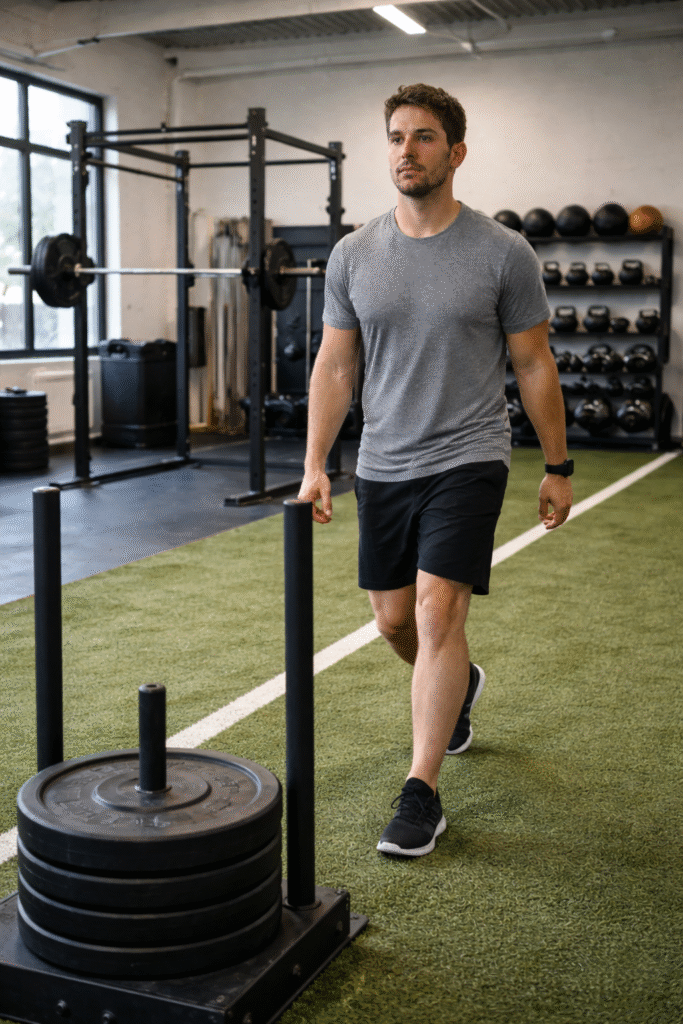
    Athlete walking on turf gym floor toward a sled push after finishing a weightlifting set, modern strength and conditioning gym with racks and weights in the background, natural lighting, realistic functional fitness training environment, documentary photography style.

    This type of hybrid training helps improve endurance, strength, and overall fitness without forcing you to choose between looking strong and feeling athletic.

    Why Most People Avoid Strength and Conditioning Training

    Many people avoid this type of training because they think they have to choose one path. Lifters sometimes worry that conditioning will make them lose muscle. People who prefer cardio may avoid weights because they think strength training will slow them down. In reality, combining both usually leads to better results than focusing on only one.

    Most people train for comfort, not for capability. They stay with what feels familiar, even if it is not helping them progress. Strength and conditioning training requires more balance and patience, but it builds the kind of fitness that lasts longer than any short-term program.

    Build a Spring Fitness Routine That Lasts All Year

    Man and woman walking out of a gym together after a workout, gym bags over their shoulders, warm sunset lighting, relaxed and accomplished mood, modern gym exterior, realistic fitness lifestyle photography with a spring atmosphere, documentary style.

    Spring is indeed when motivation starts to come back, but motivation alone does not create results. What matters is what you build when that motivation shows up. This season is the perfect opportunity to start training in a way that develops strength, endurance, and consistency at the same time.

    Instead of repeating the same cycle every year, spring can be the moment you begin building a routine that actually carries forward. Strength and conditioning training is not just a way to get in shape for the season. It is a way to create a level of fitness you can keep year-round.


    Fitness professional standing with arms crossed, wearing a black sleeveless hoodie and cap, calm confident expression against a clean neutral background.

    Interested in training with me or just want to connect?
    Send a DM to @Litoswaay, or email Carlos@ConditionedLiving.com, I’d love to hear from you!
    Follow @ConditionedLiving for reflections, tips, and updates on mindset, strength, and everyday wellness.
    Stay in the loop by joining my free mailing list for updates and inspiration.

    Additionally, download the free guide A Sustainable Start to begin your journey toward sustainable strength and wellness, with a focus on consistency and balance.


  • Strength-Aware Conditioning: How to Improve Cardio Without Losing Strength

    Strength-Aware Conditioning: How to Improve Cardio Without Losing Strength

    A smarter approach to conditioning that supports strength, recovery, and long-term progress

    Person resting between strength and cardio training in a quiet gym environment, reflecting a balanced approach to conditioning and strength.

    Conditioning has long occupied an awkward space in fitness culture. For some, it’s synonymous with long bouts of cardio that slowly chip away at strength. For others, it shows up as aggressive finishers that feel productive in the moment but quietly undermine recovery and technique.

    Both approaches tend to miss the same point. Conditioning is often treated as something separate from strength, rather than something that should work in coordination with it.

    Strength-Aware Conditioning starts from a different premise. Conditioning should support how strength is produced, respect how movement quality changes under fatigue, and, of course,  how the body recovers between sessions. When conditioning understands those constraints, it becomes a tool for progress instead of a source of friction.

    Where Traditional Conditioning Misses the Mark

    Most conditioning programs fall into familiar patterns. Long, steady sessions can build endurance but often ignore muscle balance, joint stress, and the recovery demands of strength training. On the opposite end, high-intensity circuits frequently stack complex movements under fatigue, encouraging breakdown in mechanics and unnecessary strain.

    Empty gym space with cardio and strength equipment, representing common conditioning approaches that lack balance or structure.

    This disconnect is especially noticeable for people returning to fitness after time off. When conditioning is too aggressive or poorly timed, it can create setbacks instead of momentum, leaving people sore, discouraged, or hesitant to train consistently.

    The issue isn’t conditioning itself. It’s conditioning that doesn’t account for how strength actually works.

    Defining Strength-Aware Conditioning

    Strength-Aware Conditioning is conditioning that understands movement first and intensity second. It raises heart rate and metabolic demand while preserving technique, joint integrity, and force production.

    This approach emphasizes:

    • Clean movement patterns under moderate fatigue
    • Controlled breathing and effective bracing
    • Sustainable intensity that supports consistent training
    • Conditioning that complements strength rather than competing with it

    It aligns naturally with building sustainable fitness habits that prioritize long-term consistency over short-term intensity. The goal is not to survive a workout, but to leave a session better prepared for the next one.

    A Practical Example of Strength-Aware Conditioning

    A simple example combines low-impact cardio with a foundational strength movement.

    A short, moderate-intensity effort on a spin bike elevates heart rate and creates muscular fatigue in the legs without impact. Resistance is high enough to require intent, but not so high that cadence breaks down. Immediately transitioning to a moderate-load deadlift asks the body to produce force while breathing remains elevated, and the legs already feel heavy.

    The structure is deliberate. Rep counts are kept low enough to protect hinge mechanics. Rest periods are short enough to maintain cardiovascular demand without allowing technique to deteriorate. Across multiple rounds, the body learns to coordinate breathing, bracing, and force production under controlled fatigue.

    This is conditioning that reinforces skill rather than chaos.

    Why This Approach Works

    Strength-Aware Conditioning works because it respects how the body adapts. The cardiovascular system is challenged without being overwhelmed. Muscles stay engaged without being pushed to failure. Technique remains intact even as fatigue accumulates.

    Over time, this improves work capacity, recovery between efforts, and confidence under load. Strength sessions begin to feel more stable rather than draining. Conditioning becomes something that supports progress instead of interrupting it.

    Muscle Building and Strength-Aware Conditioning

    Strength-Aware Conditioning is not a replacement for hypertrophy-focused training or heavy strength work. Its role is supportive.

    Lower body strength training with moderate load, representing muscular endurance and supportive conditioning for strength development.

    This style of conditioning builds muscular endurance, reinforces movement patterns, and improves recovery between sets and sessions. These adaptations allow higher-quality strength training across the week. Rather than directly chasing muscle growth, it creates the conditions that allow muscle growth to happen consistently.

    In that sense, it functions as connective tissue between strength sessions, helping maintain progress without pushing the body into burnout.

    Who This Approach Is For

    Strength-Aware Conditioning is especially effective for people who want to improve cardiovascular fitness without sacrificing strength. It works well for:

    • Lifters who feel gassed during compound movements
    • Endurance athletes adding strength
    • Anyone pursuing fat loss while protecting muscle and joint health

    It is conditioning for people who care not only about effort, but also about longevity.

    Work That Understands Strength

    Conditioning doesn’t need to be punishment. When it honors mechanics, breathing, and recovery, it becomes a skill that strengthens the entire training process.

    Strength-Aware Conditioning is not about doing less work. It is about doing work that understands strength.


    Fitness coach wearing a black sleeveless hoodie and black cap, arms crossed, standing against a light background with a focused expression.

    Interested in training with me or just want to connect?
    Send a DM to @Litoswaay, or email Carlos@ConditionedLiving.com. I’d love to hear from you.

    If you’re looking for a calm, realistic way to get started, you can also download my free guide, A Sustainable Start, which walks you through building strength, conditioning, and consistency without burnout or pressure.

    Follow @ConditionedLiving for reflections, tips, and updates on mindset, strength, and everyday wellness.
    Stay in the loop by joining my free mailing list for updates and inspiration.

fb-share-icon
Instagram