
There is a particular kind of satisfaction that comes from leaving the gym completely exhausted. You are sweating, your heart is pounding, your muscles feel heavy, and there is a comforting sense that you “did something.” For many people, that feeling becomes the primary measure of a good workout. If it was hard, it must have been effective. If you are tired, you must be making progress.
That assumption deserves a closer look.
Feeling worked and actually building strength are not the same thing. Yet the two are constantly confused. This misunderstanding is one of the most common reasons people train consistently for months, sometimes years, without seeing meaningful improvements in strength, body composition, or performance.
Why Feeling Tired Doesn’t Always Mean You’re Getting Stronger
Exercising is very good at creating the illusion of progress because it provides immediate feedback through physical sensations. A high heart rate feels athletic. Muscle burn feels productive. Next-day soreness feels like proof that something “worked.” These signals are loud, emotional, and convincing.

The problem is that your body does not change based on how tired you feel. It changes in response to the stimulus you apply repeatedly and progressively. You can push yourself to exhaustion with random circuits or constantly varied workouts and still never build meaningful strength. Fatigue is easy to accumulate but adaptation is a little more specific.
Strength Training vs Exercising: Understanding the Critical Difference
Exercising is centered around activity. It is movement for calorie burn, stress relief, or general fitness. There is nothing inherently wrong with that. General exercise is beneficial for health and well-being.

Training, however, is designed to produce adaptation. Strength training follows structure, uses measurable variables, and applies progressive overload over time. Instead of asking, “How hard did this feel?” training asks, “What is improving?”
Exercising focuses on effort and training focuses on development. Confusing the two is where stagnation begins.
Signs You’re Actually Building Strength in the Gym
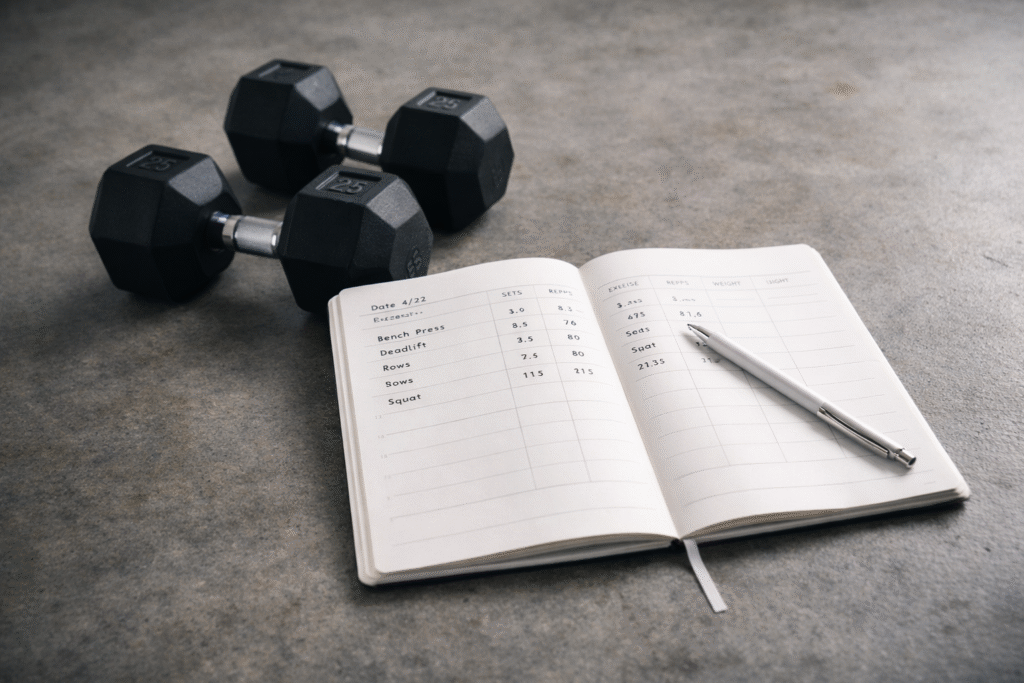
Real strength gains leave measurable clues, even when progress feels slow. You may be building strength if you notice that weights are gradually increasing, repetitions improve at the same load, movements feel more stable, and recovery becomes easier between sessions.
Strength progress is rarely dramatic day to day. It accumulates quietly through consistency and progression. These are performance-based indicators rather than emotional ones.
Without tracking, however, these improvements are easy to miss or may never occur at all.
Signs You’re Exercising Without Making Strength Progress

Many people drift unknowingly into a pattern of high effort without adaptation. Workouts feel consistently difficult, yet strength does not improve. There is little awareness of what was lifted last week. Programs change frequently. Sweat becomes the success marker. Fatigue becomes chronic.
High effort without progressive overload is simply repeated stress. Repeated stress without adaptation becomes wear and tear rather than growth.
Why Progressive Overload Matters for Muscle and Strength Gains
Strength training works because it challenges the body in a way that demands change and that challenge must increase over time. If the load never progresses, the stimulus eventually becomes maintenance at best.

This is why understanding intensity is essential. Many people work hard but not hard enough in a way that forces adaptation. If this sounds familiar, give Are You Lifting Heavy Enough? A Simple Guide to Muscle Growth and Fat Loss a read. It clarifies one of the biggest gaps in most training routines.
Conditioning vs Strength Training: How to Balance Both

Conditioning workouts create strong sensations of effort, but they do not automatically build strength. Conditioning improves cardiovascular health, endurance, and work capacity. Strength training improves force production, muscle development, and structural resilience.
These systems support each other when programmed intentionally. Structured pairings like those discussed in Spin Bike and Deadlift Combo: A Lower Body Strength and Conditioning Circuit succeed because they blend modalities with purpose instead of randomness.
Always remember, random intensity scatters adaptation and structured intensity directs it.
Reframing Your Workouts for Real Strength Progress
When effort is high but results are missing, the solution is rarely “work harder.” More often, the answer is clarity and structure. Tracking lifts, anchoring workouts around compound movements, applying progressive overload, and reducing unnecessary randomness can dramatically change outcomes.
Fatigue should not be confused with effectiveness.
Exhaustion should not be the goal.
Adaptation should.
Many people believe they lack discipline when the real issue is direction. They often assume stagnation means they are not motivated enough or genetically gifted. In reality, they may be exercising consistently rather than training progressively.
Effort may not be the problem, it could simply by direction.
Interested in training with me or just want to connect?
Send a DM to @Litoswaay, or email Carlos@ConditionedLiving.com.
If you’re looking for a calm, realistic way to get started, you can also download my free guide, A Sustainable Start, which walks you through building strength, conditioning, and consistency without burnout or pressure.
Follow @ConditionedLiving for reflections, tips, and updates on mindset, strength, and everyday wellness. Stay in the loop by joining my free mailing list for updates and inspiration.